
Baked Potato Super Live: Before Gigs Needed an Audience

For many music fans, the late seventies and eighties remain a high-water mark — not just for popular music, but for musicianship itself. It was a brief moment when commerce, craft, and curiosity aligned. MTV had arrived. Baby boomers had money. Albums — not singles — became the dominant artistic unit. And artists were given the time, budgets, and talent to explore.
Michael Jackson’s Thriller was the apex of that moment: culturally dominant, artistically ambitious, and meticulously constructed. It didn’t happen by accident.
A large part of the answer lies in Los Angeles.
As pop music shifted from New York’s Brill Building assembly line to the singer-songwriter culture of Laurel Canyon and Topanga, LA became the industry’s gravitational center. Warner Brothers, Capitol, A&M, Epic, even Motown — all headquartered there. Studios were lavishly funded. The best gear lived in one place. And just as important, so did the best players.
Studio musicians had always been essential. In the 1960s, the Wrecking Crew and the Funk Brothers quietly shaped hit after hit. So did the Muscle Shoals Swampers. So did Steve Cropper, Duck Dunn, and Booker T. — musicians whose names were often unknown to the public but deeply understood inside the industry.
Bands sometimes bristled at the arrangement. The Byrds famously learned — ink barely dry on their first contract — that the Wrecking Crew would be playing their parts. They were offended. That feeling subsided once the royalty checks arrived.
As pop music evolved into an album-driven medium, bands insisted on playing their own instruments. The Wrecking Crew era faded. But something unexpected followed: a new generation of studio musicians emerged — players who weren’t just efficient, but deeply musical. They cut their teeth on film scores, television, and jingles. Steely Dan abandoned the idea of a fixed band altogether, drawing instead from an elite pool of specialists.
By the early ’80s, the studio scene was thriving again.
Look at the Grammy winners for Album of the Year during that decade. Nearly all were studio-centric productions. Even the two “band” winners — Toto and U2 — leaned heavily on session-level collaboration. U2 had Brian Eno and Daniel Lanois shaping their sound. Toto, well… that band was studio dudes.
Jeff Porcaro and Steve Lukather embodied the era. As members of Toto, they were already successful. As session musicians, they were everywhere. Porcaro’s feel — elastic, precise, unshakable — and Lukather’s melodic, overdriven voice made them first-call players. They worked so constantly they routinely turned down major artists.
And then, on Sunday nights, they played for fun.
That brings us to Baked Potato Super Live, credited to the Greg Mathieson Project.
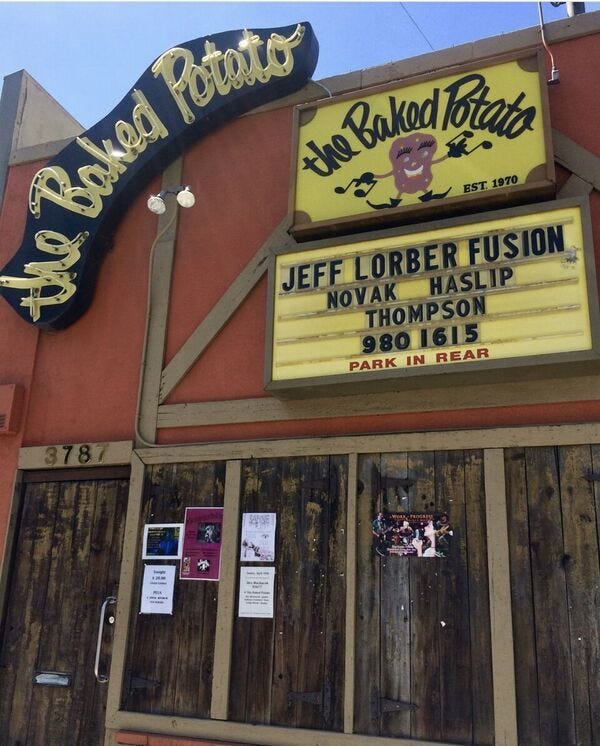
The “Project” was an ongoing Sunday night residency at the Baked Potato, a small jazz club in North Hollywood. For years it was a well-kept secret. Studio giants — Larry Carlton, Abe Laboriel, Jimmy Johnson, Carlos Vega, Lenny Castro, Porcaro — showed up after the week’s work was done. Freed from charts, producers, and the clock, they played.
Los Angeles musicians knew to check the LA Times Sunday Calendar listings early. Seats disappeared fast. There was often a line out the door.
In 1981, Larry Carlton — an LA native from Torrance — handed guitar duties to a 24-year-old Steve Lukather. A daunting inheritance. But Lukather was on fire. His range alone was extraordinary. Listen to his playing on Boz Scaggs’ “A Clue” and “Breakdown Dead Ahead” — it sounds like two different guitarists inhabiting the same body.
When Super Live was recorded, Lukather was also deep into work on Toto IV. “Rosanna” and “Africa” were still ahead of him. So were his lead vocals and songwriting successes. This was the hinge point — expectations meeting confidence.
If you want to hear the sound of experts enjoying their own abilities, this record captures it.
The opening track, “Bomp Me,” says everything immediately. Porcaro’s bass-drum triplets never relent. Lukather’s chorus-washed rhythm explodes into a whammy-bar solo that feels almost giddy in its freedom. This isn’t a twelve-bar cameo. It’s a musician finally allowed to speak in full sentences.
Not every track hits with the same intensity, but the groove never loosens. These players don’t compete; they complement. Pops Popswell anchors the bass with authority and restraint. Mathieson’s Hammond work grounds the band and gives the music shape.
Still, this is Porcaro and Lukather’s show — two high-school friends playing at the edge of their powers. If you listen closely, you can hear the smile — and practically see Jeff’s big white chompers practically visible — in the groove.

Listening now, what’s striking isn’t nostalgia — it’s chemistry.
Does anyone remember chemistry?
These players assumed mastery mattered. That curiosity was how you earned it. That time spent getting better wasn’t something to apologize for — it was required if you wanted to play.
These guys, on their night off no less, were just doing the work together because it was interesting and fun.
That way of working hasn’t disappeared entirely. There are always a few following their own muse. But it’s rare now. And good luck finding a Baked Potato in your town — especially if your first instinct is to look for it on your phone.